FREE ON-DEMAND TRAINING FOR HEALTHCARE PRACTITIONERS

The 10 Questions You Must Ask Before You Trust Any Functional Lab Test

Instead of taking the results at face value, learn whether a lab test is worth running in the first place.

Before you spend hundreds of dollars on a lab test, it must first answer these 10 questions.

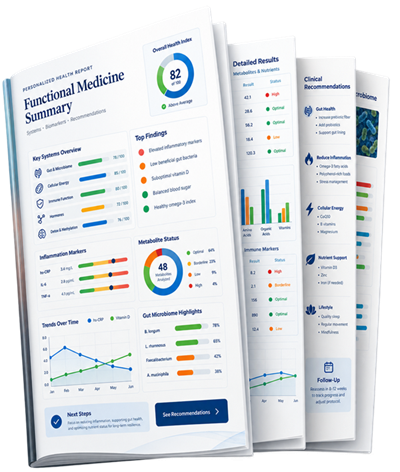
You know the kind of report

Twenty pages long
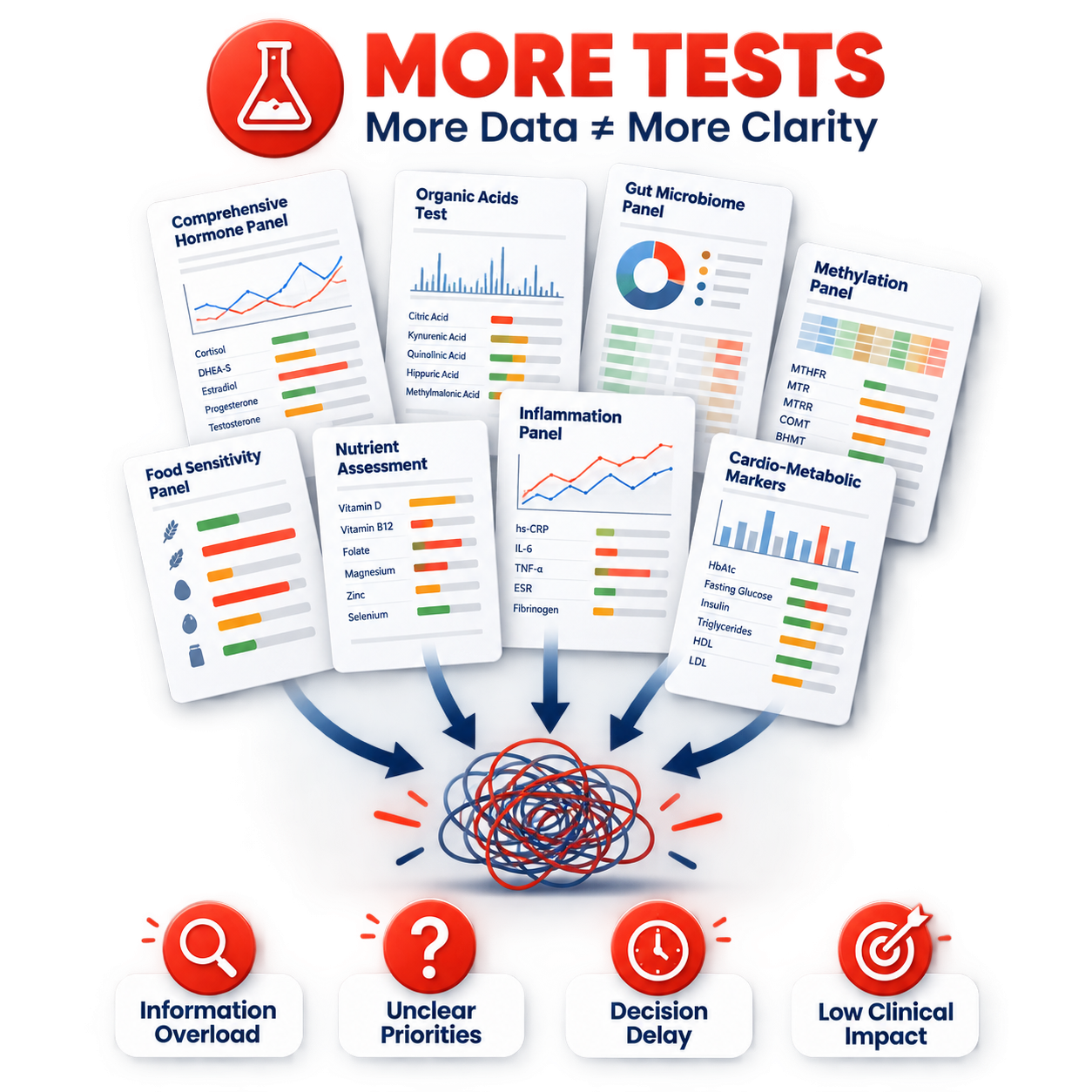
Red flags. Yellow flags. Graphs. Percentiles. Organisms. Metabolites. Antibodies. Ratios.
Recommended interventions attached to the abnormal findings.
Everything about the presentation looks confident.
The report has built the case for you.
This is abnormal.
This is what it means.
This is what you should do about it.

What Almost Nobody Was Actually Taught

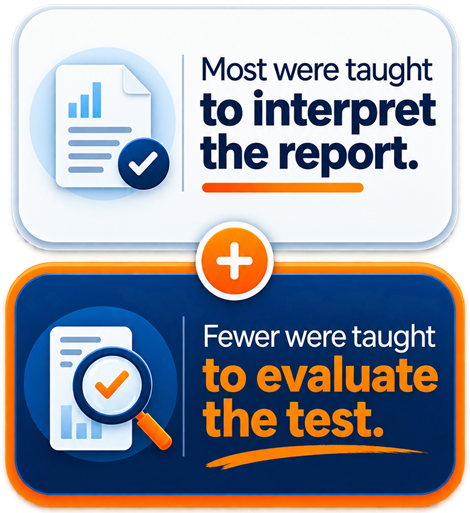
Most of us were taught to interpret the results before anyone taught us to evaluate the test.

In fact, most of us spend our time learning how to interpret a test and read the report. 

Yet, almost no one knows how to decide whether the report deserves to be read that way in the first place.

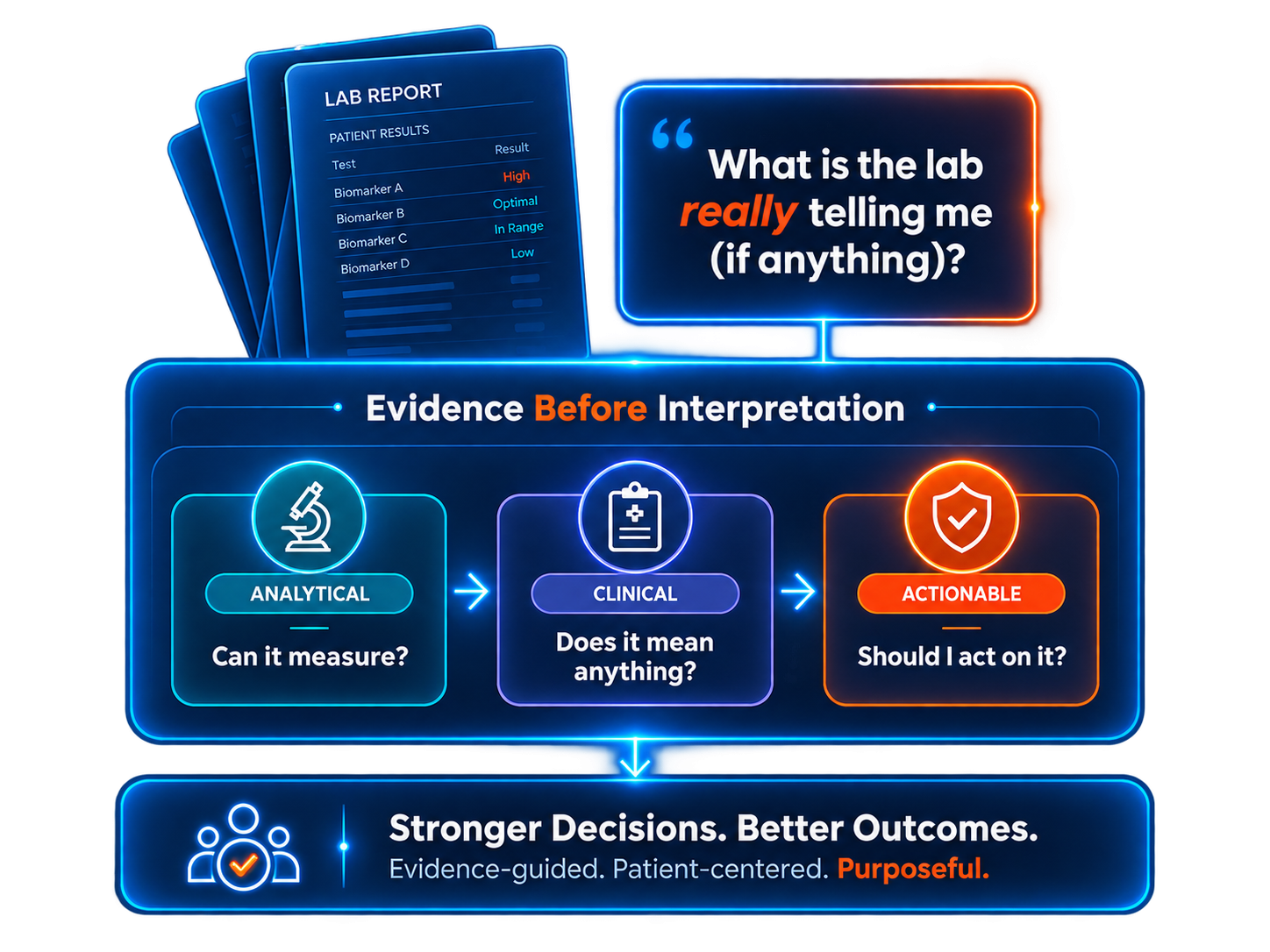
Those are two different skills. One assumes the test is valid and works out what to do about the numbers. The other asks whether the numbers, as reported, can legitimately support the clinical conclusions attached to them.

It's not really your fault - laboratory education, conventional and functional alike, tends to start at the report. Here is the marker. Here is what elevated means. Here is the pathway involved. Here are the interventions to consider.


A Lab Result is Never Neutral

All tests reveal something.

Sometimes it is a marker; other times it is a mechanism. Maybe it's a number or reference range, but they always produce some type of information. 

That doesn't mean they produce useful information. 

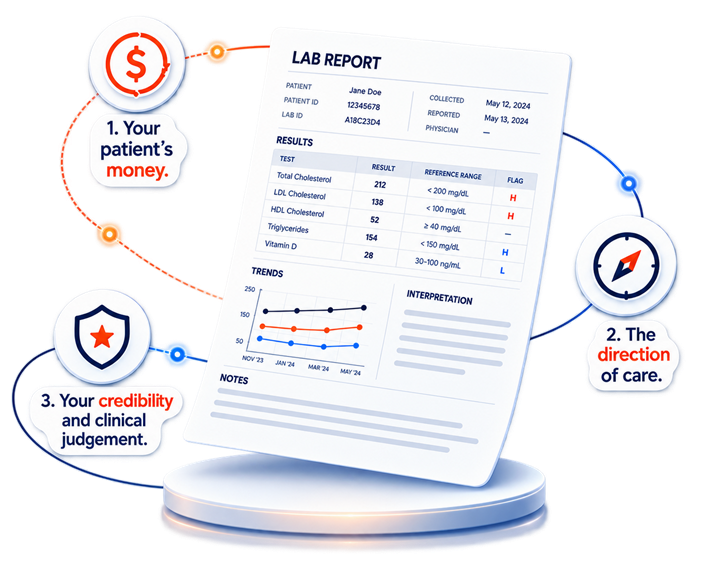
However, every test you order spends at least three things every time you order it:
Your patient's money
The direction of care
Your credibility and clinical judgement
That is some serious influence and frankly, a test should have to earn its ability to have that much influence and power before it is used.

That's Why I Started Asking 10 Questions

Not ten more markers to memorize.
Not another set of "optimal" ranges.
And not ten reasons to stop ordering specialty testing.
Only 10 questions. Simple questions. But sometimes surprisingly difficult to answer.
And when you start asking these questions in order, some very impressive-looking tests begin to look different.
Others hold up better than you might expect.

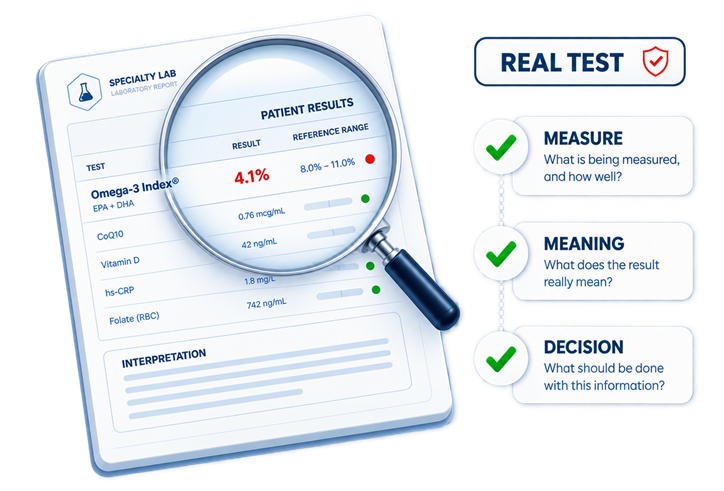
In this free training, I'll show you what happens
when a real test has to answer the questions.

Why “accurate” and “reproducible” are not the same thing
The question hiding behind every “normal” and “optimal” range.
Where biological plausibility stops and clinical validation begins.
How to tell whether an expensive test adds something you didn't already know.
What evidence tells us that acting on the result actually helps the patient?

Being Thorough Does Not Mean Ordering More Tests

This part matters.

A lot of us were drawn toward functional and integrative medicine because we wanted to look deeper.

We didn't want to dismiss something simply because conventional medicine wasn't interested in it yet.

More curious. Less dismissive. More willing to investigate what a shorter appointment might overlook.

There is nothing wrong with that instinct.

But being thorough does not mean ordering more tests. It means knowing which information deserves to influence your decisions, and being able to explain why.

Some of what you already order will meet that bar. Some may not. Some may meet the bar for one purpose and fail it for another. Knowing which is which is the next step for a thoughtful practitioner, not a retreat from thoroughness.

Who This Is For

Many practitioners entered integrative and functional work because they wanted to be more thorough than the conventional standard. More curious. Less dismissive. More willing to investigate what a shorter appointment might overlook.

That instinct is not what this training questions.

Being thorough does not mean ordering more tests. It means knowing which information deserves to influence your decisions, and being able to explain why.

Some of what you already order will meet that bar. Some may not. Some may meet the bar for one purpose and fail it for another. Knowing which is which is the next step for a thoughtful practitioner, not a retreat from thoroughness.

Why I Made This Training

I've spent years teaching practitioners physiology and laboratory interpretation.

And the deeper I went into the literature behind individual tests, the more interested I became in a question that comes before interpretation:

What is the lab really telling me (if anything)?

Not what sounds plausible.
Not what the report implies.
Not what a respected educator says.
Not even what I personally happen to believe.

The Ten Questions
grew out of that problem.

They're now the standard I want a test to face before I let the result carry significant weight in a clinical decision.

In this training, I'll show you how I use them.

FAQ

Are you saying specialty or functional tests are useless?
No. Some tests may hold up very well. Some may be useful for a specific purpose but overinterpreted for others. Some have important limitations. Some may have inadequate support. The goal is to know the difference.

Is this an attack on functional medicine?
No. The same questions can be asked of conventional laboratory tests.
This is about standards of evidence, not which side of medicine somebody identifies with.

Is this only for physicians?
No. It is written for any practitioner who orders, interprets, recommends, or encounters specialty laboratory testing. That includes physicians, NPs, PAs, NDs, chiropractors, dietitians, nutrition professionals, pharmacists, and experienced health coaches.

Something To Think About

Your patient probably isn't going to read the analytical validation paper.

They aren't going to track down the study behind the reference interval.

They aren't going to compare the assay against a reference method or ask whether anybody has demonstrated clinical utility.

They are trusting you
to decide how much weight this information deserves.

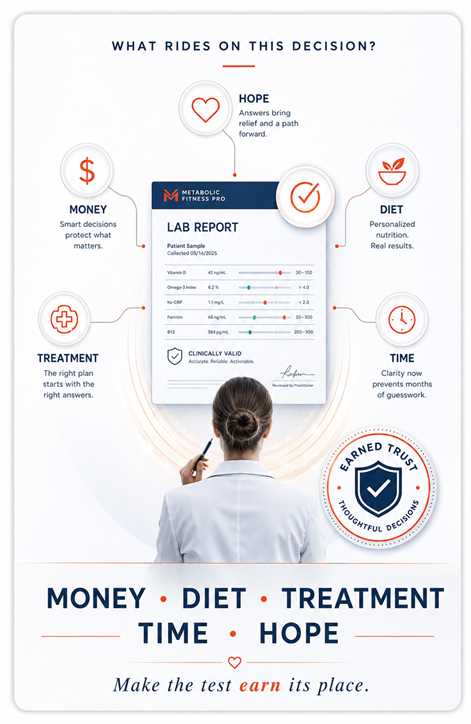
And sometimes that patient is putting a lot behind that decision.

Their money.
Their diet.
Their treatment.
Their time.
And often their hope that this test might finally explain what has been going on.

You don't need to distrust every test.

You just need a better way to know when trust has been earned.

Before the next report becomes the next treatment plan, make the test earn its place.

A Better Test Starts With a Better Question

Know What to Test Next
Identify what matters and target the real clinical question.
Use Fewer, Better Markers
Select focused marker sets that deliver clarity without waste.
Interpret Results with Discipline
Analyze findings in context to avoid overreaction.
Identify the Clear Next Step
Make confident decisions that improve outcomes .

JOIN US LIVE

Free live webinar
60 Minutes
Case-based training
Clinically actionable 
Question      🡪
Marker      🡪
Meaning  🡪
Move
Presented by Dr. Bryan Walsh
Clinical educator, co-founder of Metabolic Fitness Pro, and trusted voice in physiology-first laboratory interpretation.

Dr. Walsh helps practitioners connect biochemistry to real patients, integrating advanced testing, nutritional biochemistry, and practical clinical decision-making.
Small text.25+ years in clinical practice and laboratory education
Expert in biochemistry, physiology, and functional laboratory analysis
Thousands of practitioners trained worldwide

Better questions. Better data. Better outcomes.

Join us live and elevate the way you think about advanced blood chemistry.